
Neuland Website
.png)
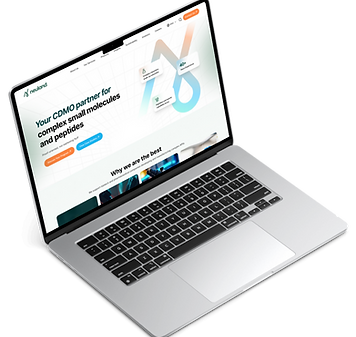
An AI-Powered website to engage API buyers for the CDMO services
Client
Neuland Laboratories
Year
2026
Design Tools

Figma & Make
.png)
Claude

ChatGpt

UseBerry
Objectives
Neuland Labs operates in a high-consideration, trust-driven pharmaceutical and biotech ecosystem, where users expect scientific depth, regulatory confidence, and ease of evaluation before initiating engagement. The current website partially serves these needs but does not yet fully match the experience benchmarks set by global CDMO and API leaders.


Persona-Driven UX
-
By aligning the website experience to real user needs and global benchmarks, Neuland can:
-
Reduce time-to-trust for new visitors
-
Improve engagement and lead quality
-
Position itself as a modern, globally competitive CDMO & API partner
-
Convert the website from a passive information hub into an active growth enabler


Summary
-
The Neuland website serves four primary audiences: Investors, CDMO Prospects, API Buyers, and Job Seekers, each with different but related objectives.
-
Investors visit to evaluate the company’s financial stability, governance practices, and long-term growth potential.
-
CDMO prospects look for scientific capabilities, development expertise, and partnership opportunities for drug development and manufacturing.
-
API buyers focus on product portfolio, regulatory compliance, manufacturing scale, and supply reliability.
-
Job seekers explore the website to understand career opportunities, company culture, and professional growth prospects.

Purpose
Neuland’s website has parity or superiority in substance compared to competitors, but falls behind in experience design, clarity, and engagement strategy. The revamp is focused on:
-
Aligning content and navigation to distinct user personas
-
Elevating differentiation and value proposition early
-
Simplifying complex information through visual hierarchy and modular content
-
Matching global competitors in UI polish, performance, and conversion design

Key Observations & Competitive Takeaways
Homepage & Messaging
-
Competitors lead with clear value propositions and structured hero sections (e.g., Lonza, Samsung Biologics).
-
Neuland’s homepage could improve by highlighting core value statements, top services, and persona pathways up front.
Mobile UX
-
Competitors (Patheon, Catalent, WuXi) have smooth mobile interactions with dynamic menus and clear CTAs.
-
Neuland’s mobile UX is functional but would benefit from fixed CTA bars and condensed menus.
CTA Strategy
-
Leaders use primary actions early and contextually (request capability, contact experts, download brochures).
-
Neuland should elevate CTAs across the homepage and service pages.
Accessibility
-
Most competitors score high on accessibility fundamentals like semantic tags and keyboard navigation.
-
Neuland’s current site is fairly accessible but should aim for WCAG AA compliance consistently across pages.
Navigation
-
Best-in-class sites use audience-oriented navigation (e.g., “For Biotech”, “For Pharma”).
-
Neuland currently uses flat nav; adopting segmented menus would improve findability and reduce drop-offs.
Visual Consistency
-
Global sites invest in consistent brand and component libraries (e.g., Samsung Biologics, Lonza).
-
Neuland's design could align better with corporate standards for cleaner typography and spacing.
Information Architecture
-
Strong IA means content flows from general → specific → action. Competitors structure pages with clear sections and breadcrumbs.
-
Neuland’s IA feels flat; creating persona flows and secondary nav will help.
Trust Building Elements
-
All competitor sites prominently display certifications, approvals, partner logos and case studies.
-
Neuland should elevate trust elements near top of critical pages.
Overview
Merging the primary and secondary headers simplifies navigation by reducing visual clutter and cognitive load, allowing users to focus on key actions more efficiently. It improves information hierarchy by prioritizing important sections, while also increasing above-the-fold space for impactful content. This approach creates a cleaner, more modern and premium experience aligned with global design standards, enhances responsiveness across devices, and ensures better performance and consistency throughout the website.

High Fidelity Design Version 1
-
Simplicity & Narrative: Using Hick’s and Miller’s Laws, we apply visual restraint and "chunked" storytelling to guide users without cognitive overload.
-
Hierarchy & Space: Grounded in Proximity and the Von Restorff Effect, we use strategic spacing and bold typography to anchor attention and organize complex data.
-
Engagement & Logic: Based on Fitts’s and Jakob’s Laws, we place accessible CTAs at natural decision points using familiar enterprise patterns.
-
Retention: The Picture Superiority Effect ensures complex innovations remain memorable through meaningful, intentional imagery.
.png)

%201.png)

High Fidelity Design Version 2
-
Simplicity & Narrative: Using Hick’s and Miller’s Laws, we apply visual restraint and "chunked" storytelling to guide users without cognitive overload.
-
Hierarchy & Space: Grounded in Proximity and the Von Restorff Effect, we use strategic spacing and bold typography to anchor attention and organize complex data.
-
Engagement & Logic: Based on Fitts’s and Jakob’s Laws, we place accessible CTAs at natural decision points using familiar enterprise patterns.
-
Retention: The Picture Superiority Effect ensures complex innovations remain memorable through meaningful, intentional imagery.
High Fidelity Design Version 3
-
Simplicity & Narrative: Using Hick’s and Miller’s Laws, we apply visual restraint and "chunked" storytelling to guide users without cognitive overload.
-
Hierarchy & Space: Grounded in Proximity and the Von Restorff Effect, we use strategic spacing and bold typography to anchor attention and organize complex data.
-
Engagement & Logic: Based on Fitts’s and Jakob’s Laws, we place accessible CTAs at natural decision points using familiar enterprise patterns.
-
Retention: The Picture Superiority Effect ensures complex innovations remain memorable through meaningful, intentional imagery.
.png)
.png)
High Fidelity Design Version 4
-
Simplicity & Narrative: Using Hick’s and Miller’s Laws, we apply visual restraint and "chunked" storytelling to guide users without cognitive overload.
-
Hierarchy & Space: Grounded in Proximity and the Von Restorff Effect, we use strategic spacing and bold typography to anchor attention and organize complex data.
-
Engagement & Logic: Based on Fitts’s and Jakob’s Laws, we place accessible CTAs at natural decision points using familiar enterprise patterns.
-
Retention: The Picture Superiority Effect ensures complex innovations remain memorable through meaningful, intentional imagery.
Audit based on UI UX Decisions
-
Weak First Impression: Recommends replacing generic headlines with benefit-driven messaging and moving primary CTAs above the fold.
-
Navigation & Personas: Suggests shifting from internal structures to persona-based navigation (e.g., "For Biotech") to guide specific user groups.
-
Content Density: Addresses "overwhelming" technical blocks by recommending bullet points, accordions, and progressive disclosure.
-
Inconsistent CTAs: Proposes a clear hierarchy for action-oriented steps, like "Request a Meeting," to replace passive "Read More" links.
-
Mobile Experience: Identifies "mobile fatigue" and suggests mobile-first layouts with fixed/floating CTAs and reduced hero heights.
-
Visual Hierarchy: Recommends a refined design system with a modern typography scale, updated icons, and strategic use of depth and spacing.
-
Performance & Speed: Highlights the need for image optimization (WebP/AVIF) and reducing layout shifts to improve professional trust.


Audit based on Performance
-
Critical Speed Risks: Slow load times—specifically high Largest Contentful Paint (LCP) and First Contentful Paint (FCP)—create a weak first impression and high bounce risk.
-
Mobile Performance Gap: Mobile users experience extreme friction due to heavy scripts and long blocking times, leading to site abandonment before the brand's value is even understood.
-
Visual Instability: High Cumulative Layout Shift (CLS) causes content to jump during loading, which breaks the reading flow and reduces confidence in the organization's "pharma-grade" reliability.
-
Asset & Script Bloat: Unoptimized images and excessive, unused JavaScript create "visual noise" and sluggish interactions. This large DOM size results in delayed clicks and scrolls, making the site feel unresponsive and difficult to scale.